
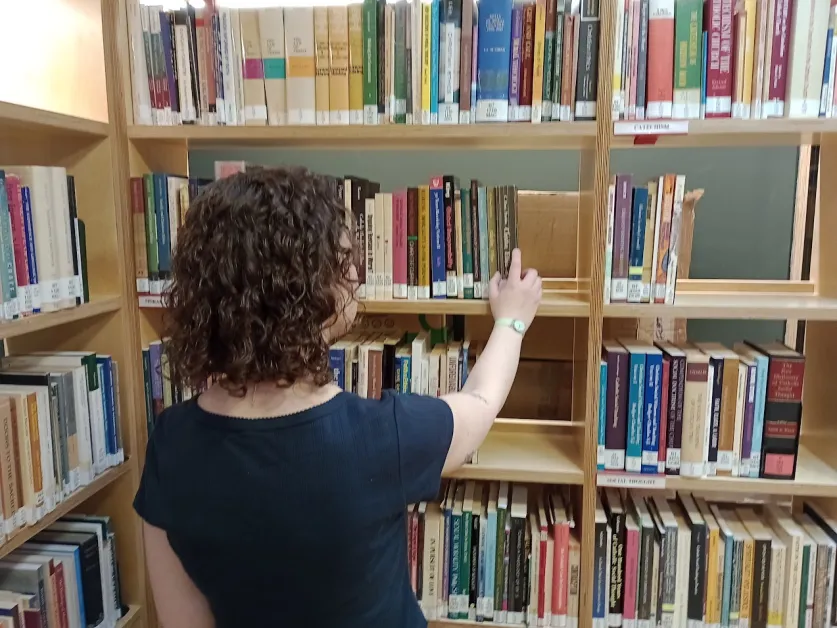
This ‘A Day in the Life’ post shares what a typical working day might look like for Heythrop Library’s Assistant Librarian. Although no two days are the same, the following timetable offers a glimpse into how I organise my work, in addition to handling reader enquiries (in person, emails, phone calls) throughout the day.
9:30-10:00
First things first: opening procedures! I switch on the lights, boot-up the library computers, and open the windows to get some fresh air into our basement-level reading room. I get down to tackling new emails in our shared inbox, where there are several membership applications to process.
10:00-11:00
Awaiting me in reception is a stack of post that needs my attention. These are mostly new journal issues which have arrived as part of our various serial subscriptions. I check these issues in on our library management system Koha: this involves marking them as received, classmarking them, giving them barcodes so they can be found on the catalogue, and shelving them in the correct pigeonholes in the reading room, ready to be consulted by our patrons. This is also the time to chase publishers for any issues not received. Most of our journal subscriptions are managed through a subscription agent, which streamlines the process somewhat and makes claiming for missing issues slightly less of an ordeal. Fingers crossed that today’s claims will be speedily resolved!

11:00-11:15
I join my colleagues Clemens and Amelia for a tea break in the Cana Lounge of the London Jesuit Centre. It is a nice opportunity to catch up with members of staff working in other areas of the LJC.
11:15-12:00
Time for some cataloguing and classmarking of recently purchased books: this can be a time-consuming task but often an enjoyable one, as there is satisfaction to be gained from having thoroughly and accurately catalogued library materials. Classifying books as a task involves a certain level of creativity and lateral thinking to do well. I have to think not only about what the book in front of me is about, but also consider how to make the book as intuitive to discover as possible on the shelf from the perspective of a library user. I will often discuss the trickier to classify books with Clemens, as with two heads on the case we can often figure out a classmark for the book relatively quickly.

13:00-14:00
When the weather is nice, I like to go for lunch in the Mount Street Gardens just outside the London Jesuit Centre. It has some very pretty trees and is relatively tranquil considering its location in busy and built-up Mayfair.
14:00-14:30
3 times a week we process requests for materials from our offsite storage facilities. Today it is my turn to do this and I find there are 6 of them. I search for the barcodes of the requested books on Koha, and use them to place orders on our online customer portal. The system tells me they will arrive the next working day, even though they must be delivered all the way from Cheshire! I make a note of the requestor’s names so that I can email them when their books arrive.
14:30-16:00
Time to get ‘into the weeds’ for some collection pruning. A project I am currently working on is deaccessioning of older library books which are not within the scope of our collection anymore. This is a long-term, on-going project that requires chipping away at. It can be quite fun as we often find all manner of weird and wonderful books in the depths of the collection! I add any books considered as candidates for deaccessioning to our spreadsheet, making sure to include details of any special contents (like paper items tucked inside the books, or previous ownership stamps), and think about where the book’s next home could be. If the British Library doesn’t have a copy we will offer to donate it to them; if it is already in their holdings we might add it to our free books table in the reading room, or offer it to another library or second-hand bookshop in London.

16:00-16:15
Another short tea-break, and a good opportunity to check if we have any more post waiting for us in reception.
16:15-16:45
I do a stint monitoring the shared library email inbox and reply to as many as I can get to. I then choose a recently arrived new book and post about it on our Bluesky account, so that anyone who is interested can see how our collection is growing.
16:45-17:15
Journal indexing. As a second step towards managing our journals collection, I pull as many complete runs of older volumes of our journals as I can find from the pigeonholes: this frees up space for the latest issues and prevents the shelves from becoming too cluttered and difficult to browse. Any older journal volume where all issues in that subscription year are present can be indexed, and then boxed up ready to be sent offsite to DeepStore.

17:15-18:00
As the busiest period of the day begins to wind down, I take the opportunity to look into our very overdue books. Our library management system has a handy report that we can generate, showing us all of the books that are overdue within a specific timeframe. I email each patron on this list to remind them to bring back their books as soon as possible.
18:00-18:30
During term time at the LJC, the library stays open Monday-Thursday until 6:30 pm, and today I will be on-duty until closing time. I do various practical tasks in the final half-hour of the day, such as shelving returned books, updating the new books display, and replying to a few late emails that have come through. Finally it’s time for the closing procedures – shutting down the library computers, tidying trolleys into the library office, and closing windows – before heading home for the day.
SV

What are your thoughts about the above?