
My latest cataloguing discovery is that two books about flowers can tell us a lot about the expanse of Heythrop’s heritage collections. I catalogued these books about botanicals in the past couple of months and realised they each showcase different strengths in the collection.
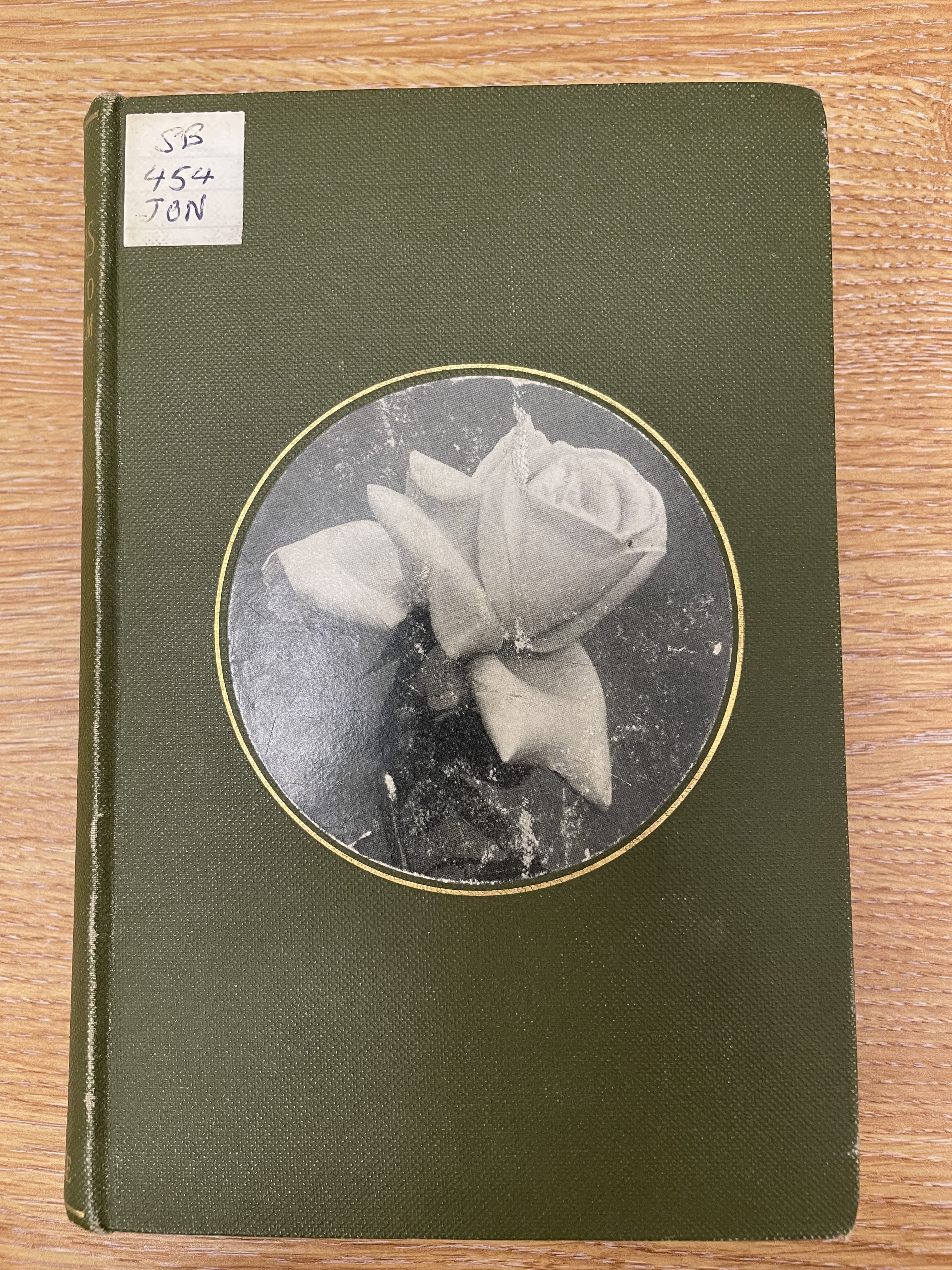
The first book I catalogued about flowers, highlights the collection areas of Christian traditions and Christian life. It is a handbook on the cultivation and selection of white flowers for Church service.

(See SB454 JON 1914 at https://hey.koha.openfifth.net/cgi-bin/koha/opac-detail.pl?biblionumber=98700)

This book not only details the growing period and how to care for flowers, but also outlines their prices. Each segment is illustrated with black and white photographs.
The second book I catalogued about flowers is a collection of the poetical works of Erasmus Darwin. Erasmus Darwin (grandfather of Charles Darwin) was a prominent natural philosopher of the 19th century. Natural philosophy was the precursor to modern sciences.

This book highlights the current collection area of philosophy and also displays the Jesuits’ interest in the development of sciences. The history of Heythrop Library is as a community library for the Jesuits. Therefore, certain books in our heritage collection support the research interests of individual Jesuits from that time.
(See PR3396 DAR V2 1806 at https://hey.koha.openfifth.net/cgi-bin/koha/opac-detail.pl?biblionumber=98785)

In his poetry (including The Botanic Garden) Erasmus Darwin emphasizes the connections between humanity and plants, arguing that they are all part of the same natural world and that sexual reproduction is at the heart of evolution. These ideas are punctuated with beautiful colour engravings.

It is so interesting to see how these books about botanicals can approach Christianity and philosophy in widely different ways. It showcases the richness and interdisciplinary nature of Heythrop’s historic collections.
AL
What are your thoughts about the above?