
For those who have looked up our catalogue or read parts of our web page covering collections, you will know that we do not provide access to any ebooks, or indeed many ejournals. There are links from our catalogue, when we have a printed copy of a book, and there is a freely-available digital version of it, but we have (so far?) not bought any books. Similarly, for ejournals we have access to some of them, in addition to our print copy subscription, or if there is no other way of having access at all (i.e. the publisher has discontinued offering print copies, and they only offer e-only access to their journal.
This has struck some of our enquirers or library members as odd. Surely, everyone is going digital. Our preference for the printed format is not based on some luddite approach to the world. Rather, it is often the commercial licensing for libraries of ebooks and ejournals which is not attractive to us. Let me explain this for journals first:
I have not heard of a single publisher which offers access in perpetuity for a journal, when you stop paying for the current or next year. So if we have an ejournal subscription we might also have access to the archives of a specific journal (often a very generous amount of past issues of this publication). As far as I’m aware, as soon as you stop subscribing to such an ejournal – i.e. us paying the institutional subscription rate – we lose access to any years we previously had access to, even if we subscribed to this ejournal for 5, 10 or more years. Ownership is not given at point of purchase – unlike a print copy of journal, which we can keep in London, send to Deepstore, or (in theory) can withdraw as we see fit, the online digital version of a journal is never ours. What is purchased with ejournals and most ebooks is access to such digital content, but only as long as you are paying for it. (I get that the costs of hosting materials is a real cost for publishers, but basically you are tied-in forever to an annual charge, and as soon as you stop… You get the idea!). Self-archiving is against the law, definitely as far as libraries are concerned, so we cannot keep a cache of ejournal issues acquired over the years. That might be a great business model for publishers, but is not a great and sustainable approach for libraries. The Heythrop Library has provided access to scholarly publications for over 4 centuries, but doing so for the next 50 or 100 years is only really possible for the historic printed publications.
For books, and ebooks there is one important other thing which a lot of students and researchers do not know. When you see a cheap Kindle version which you can purchase, we are not licensed to buy this, and provide access in this way. Instead libraries need to purchase ebooks directly from the publisher, or from ebook aggregators. Now purchasing an ebook in this way is usually a) much more expensive than buying one print copy of a book, but often smaller publishers cannot provide access to ebooks. Some books would simply not be available to the Heythrop Library, or other libraries. Also, b) some ebooks cannot be bought outright, so you have an annual charge/subscription for online access!
Other ebooks are only part of big packages, or collections of ebooks bundled together. As in, you want access to this book, access can only be purchased by purchase 100s or 1,000s of other books. Often we do not want, or need, all these other books. Some publishers and aggregators had to (or have) removed specific ebooks from packages, according to a friend of mine whose main job is providing access to ebooks. They told me that ‘Libraries tend to get about one month’s notice and the aggregator provides usage stats so that we can purchase disappearing titles if we need to’, i.e. the library then has to purchase access for individual titles after all, often at extra expense. Whilst one can purchase ebooks in ‘perpetuity’, it can happen that even these titles might be lost. According to my source ‘The cause is usually something to do with a change in the author’s rights or when one publisher has been purchased by another (larger) one. This sometimes takes the choice out of the publisher’s control, as the title gets removed from being an ebook or moves to a different owner publisher.’ I have never heard of a case that a publisher or a bookseller “recalled” a commercially-purchased print book, in fact rendering the original purchase agreement nil.
With print books you get that some imprints or specific copies are not available for purchase through a certain channel in the UK. Say, a US-published book, might only be available as a UK imprint. It is (in my experience) relatively rare for not being able to obtain a print book due to such licensing issues. Apparently, us belonging to our “sales region” might prevent us from purchasing specific ebooks from specific channels.
Finally, a lot of publishers and aggregators base the cost of an ebook on the number of students and staff at an institution. The Heythrop Library, whilst being based at the London Jesuit Centre, is not really able to provide clear student numbers for a start, we do not fit the common categorisation (we are not a Higher Education library, nor a Further Education one; we are also not really a public library, as we are solely-funded by the Jesuits in Britain). A normal research-level library is often based within a university setting, and there are even consortia (like JISC) who help to negotiate good (or better) deals for e-resources. We cannot be part of JISC, and therefore every negotiation is between us and the aggregator/publisher.
From a user point most ejournal platforms are okay – one can browse the table of contents for specific issues, or search across all issues of a journal from the publisher’s web page. The end product is often a PDF, which is very much like the print copy would be. However, for ebooks some of the ‘smaller, more niche suppliers’ (my source) have very clunky and very restrictive platform with which they offer ebooks. With a print book you have a number of flexible options, some ebooks have DRM-restrictions, or restrict how you can use the ebook.
Finally, from our point of view providing ebooks is also tricky, as we do not have, say, many students as a cohesive cohort, who year after year need online access to the same or similar books. The closest we get is the ISC students and staff, how we relate to them in a financial way is even more complicated, and maybe would burst this blog post.
With the above in mind, you can maybe see that institutional ebook or ejournal access isn’t without major pitfalls.
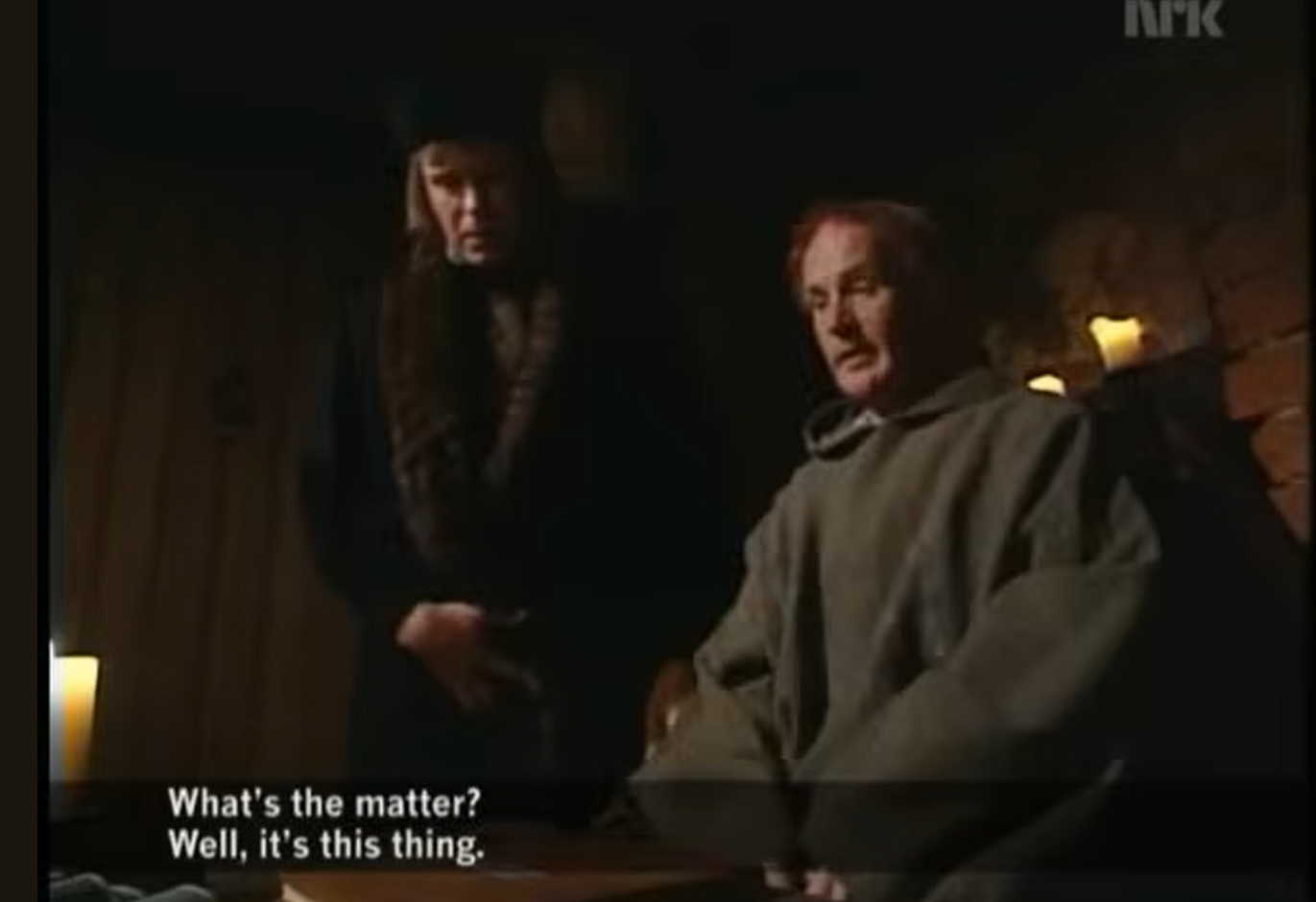
Oh, and one postlude to the image used above. The image at the top of this post is a still from a video. If you have never seen the Norwegian video titled Norwegian Medieval Tech Support (with English titles), you must! I find this extremely funny, and the overall point is we all come to problems with our own experiences and limitations.
CG
What are your thoughts about the above?