
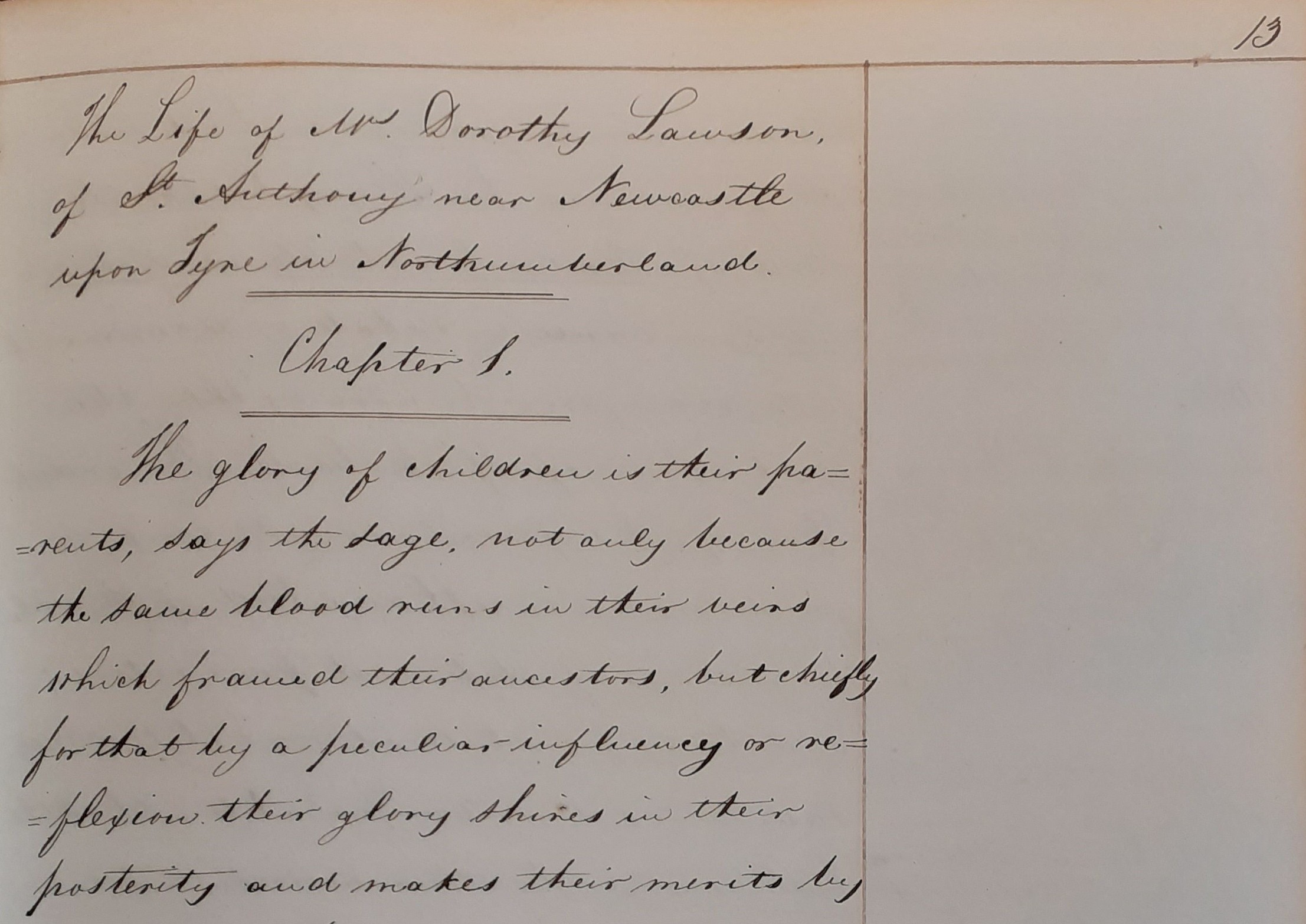
This is one of the few manuscripts in the Heythrop College Library collection, and is currently held at Campion Hall, Oxford. This blog post in two parts contains observations on the manuscript by Professor Jane Stevenson, Senior Research Fellow in English, Book History, and Women’s Studies at Campion Hall. (A description of the manuscript can be found here: BX2079 LAW/PAL 1799).
Context of the manuscript
Mrs Dorothy Lawson (1580-1632) was a wealthy widow who supported, encouraged and financed the Jesuit mission in northern England in the 17th century.
The life of Dorothy Lawson was written in manuscript by William Palmes SJ, who had been Mrs. Lawson’s chaplain for the last seven years of her life. He was born around 1594 at Naburn, in Yorkshire and became a novice at Liège in 1618.1 She died in 1632, and since Palmes mentions that he had been in her household for seven years,2 he must have come to her as a young priest in 1625. His account of her was written after 1645, since he mentions the execution of St. Henry Morse in that year. He also refers to his fourteen years of silence, which would place the writing of his memoir in 1646, fourteen years after Mrs. Lawson’s death.3
Several of Mrs Lawson’s fifteen or so children entered religion, leaving her heir, Henry Lawson of Brough Hall, to marry (Anna Hodgson) and carry on the family line. Two of her daughters were nuns in the Convent of the Immaculate Conception in Ghent, Margaret Lawson, Gertrude in religion, who professed in 1626, and Mary Lawson, Benedicta in religion, who professed in 1631. Her granddaughter Mary Lawson, Joseph in religion, joined the community in 1643. The community history notes that, ‘Lady Lucy [the founder] desired that the Fathers of the Society of Jesus should always be confessors and directors to the community … at Ghent, there was a house of English Jesuits not far from our monastery, so a continuation of their direction was easily obtained’.4 Thomas McCoog notes that Jesuit records put Palmes in Liège in 1646, so he could easily have visited the convent in Ghent.
The Heythrop manuscript – a copy of the original manuscript

The preface is dedicated to an unnamed lady, but a note in the Heythrop manuscript states that the original manuscript had belonged to the English Benedictine nuns of Ghent: ‘The original manuscript of this life was left at Gant in the Convent of the English Benedictine Dames in the year 1795, when these Ladies were (like the other English Nuns) forced to fly to England on the irruption of the Republicans into Brabant’ (page 7)5. The dedicatee is therefore almost certainly the abbess of the Convent of the Immaculate Conception, who in 1646, was Dame Mary Roper. Palmes writes, ‘my motive … is a second maternity or mother-hood in you to her children and grand-children’, strongly suggesting that his addressee was the abbess.6

Palmes’ manuscript was copied, more than a hundred years later, by a family member, Mary Anastasia Lawson. A note copied in the Heythrop manuscript states, ‘This Book belongs to Mary Lawson, begun first to be copied from the original by the Rev. Fr Ambrose Pain, of the Seraphical Order of St Francis, and finished by Sister Mary Anastasia Lawson of the third Order of St Francis at Princenhoff in Bruges’ (page 7). Dorothy Lawson’s eighteenth-century descendants seem to have switched their allegiance from the Benedictines to the Franciscans. Mary Ignatia and Mary Anastasia, daughters of Sir John Lawson, the third baronet of Brough Hall, became Franciscans in Bruges, as did Mary Seraphina, daughter of Sir Henry Lawson, the fourth baronet. Another probable member of the family, Bridget Lawson, was elected ‘first grate sister’ in 1679.7
Mary Anastasia Lawson, second scribe of the copytext for our manuscript, was born in 1713, and joined the community in 1736.8 She died in 1787. Her older sister Mary Lawson, who became Mary Ignatia, was born in 1710 and had joined ten years earlier in 1726. She is presumably the ‘Mary Lawson’ who claimed ownership of the book, as opposed to ‘Mary Anastasia’, who was its second scribe. Mary Ignatia was for many years abbess of the community, which might be a reason why her sister made her a present of the text. The initiator of the copying project was Fr Ambrose Payne, OFM, who is mentioned a couple of times in the Bruges convent annals: ‘On the 16th of Sep. 1755 was again chosen Abbess of this Monastery Sister Mary Ignatia Lawson and Str Martha Clare Halcot was Elected vicaress in which Election the very Rd Father Bernard Yeats Guardian of the Convent at Doway Presided having for his witnesses father Ambrose Pain and father Mathew Dickonson’. He appears again as a witness in 1761.9 Ambrose Payne was approved for preaching and hearing confessions in 1743 and for the mission in 1749. He died at Douai in 1772 or 1773, so was presumably a member of that community.10 There is no indication of why he undertook to make a copy of the original manuscript from Ghent, which must have been borrowed, since Mary Anastasia, who took over the project of transcription, was an enclosed nun. She may have taken it on after Payne’s death, but in any case, she faithfully returned it to the Benedictines, who then lost it in 1795 in the great scramble to escape from Belgium at the French Revolution.

The Heythrop manuscript which we have is a copy of Ambrose Payne and Mary Anastasia’s copy, made at Brough Hall. It is decorated with ‘The Coat of Arms of Mrs Dorothy Lawson viz. Lawson quartering Cramlington and Swinnow, and impaling Constable. Dedicated by her great great great great grandson Sir Henry Lawson, the transcriber of this Book, A.D. 1812. Brough Hall’ (first page). The Franciscan sisters had left Belgium in 1794 and returned to England where they settled at Winchester initially in a house belonging to Thomas Weld: in 1808 they moved to Taunton. Sir Henry Lawson, scribe of our manuscript, was the great-nephew of Mary Ignatia and Mary Anastasia Lawson. Sir John Lawson, who must have been another relative, was in touch with the nuns, since they note that in 1811 he ‘made us a present for our Altar of 6 large bouquets of artificial flowers made by the Eng: poor Clares at Scorton, formerly at Rouen’.11 Sir Henry, by implication, borrowed the Bruges copy in order to make his own, which he annotated with notes, mostly on family history. He was an antiquarian; two medieval English manuscripts owned by him are now in the Bodleian Library.12
He writes in a preface dated 1799, ‘we may reckon it as the effect of her prayers that of all her numerous descendants since the year 1632, when she died, … I cannot discover (and I have taken some pains in the research) but two individuals who have abjured that true Catholic faith which she was the cause, under God, of bringing us back to; and the number of such descendants may be fairly reckoned at more than 200, including the Lawson family …’ (pages 2-3).
Jane Stevenson,
Senior Research Fellow in English, Book History, and Women’s Studies at Campion Hall, Oxford.
To read part 2 of this text, please click on https://heythroplibrary.co.uk/2025/12/19/the-life-of-mrs-dorothy-lawson-a-manuscript-part-2/
- Thomas McCoog, English and Welsh Jesuits 1555-1650, pt 2: G-Z (London : for the Catholic Record Society, 1995), p. 259. ↩︎
- William Palmes SJ, The life of Mrs. Dorothy Lawson, of St. Antony’s near Newcastle-on-Tyne, ed. George Bouchier Richardson (London : Charles Dolman, 1855), p. 37. ↩︎
- Palmes, The life of Mrs. Dorothy Lawson, p. 35. ↩︎
- Annals of the English Benedictines of Ghent: now at St. Mary’s Abbey, Oulton in Staffordshire (privately printed, 1894), p. 9. ↩︎
- Page numbers in the body of the text refer to the location in the manuscript. ↩︎
- Palmes, The life of Mrs. Dorothy Lawson, p. 2. ↩︎
- The English Franciscan Nuns, 1619-1821, and the Friars Minor of the Same Province, 1618-1761, ed. Richard Trappes-Lomax (London : for the CRS, 1922), p. 42. ↩︎
- The English Franciscan Nuns, p. 227. ↩︎
- The English Franciscan Nuns, pp. 73, 75. ↩︎
- Fr Thaddeus, The Franciscans in England, 1600-1850 (London : Art and Book Company, 1898), p. 285. ↩︎
- The English Franciscan Nuns, p. 108. ↩︎
- MS Lat. liturgy. f.31 (fifteenth century), and Lyell 2 (twelfth century). ↩︎
What are your thoughts about the above?