
On a first and superficial look it seems like the Heythrop Library uses the Library of Congress Classification (LCC), but this is not true. There are some classmarks which look like LCC, but are in fact an adaptation: the Lynn-Peterson scheme (first edition from 1937! See https://archive.org/details/lynn-alternative-classification-for-catholic-books-1937); the second edition (with supplement) of 1965 is used by us. The Library nowadays makes also one radical change from LCC to some classmarks which are otherwise, LCC. This is part 2 of 3, to explain our classification a bit better.
Classmark areas which look like LCC, but are pure Lynn-Peterson are in:
BT = Theology
BQ = Christian Literature
The BQ element is especially confusing, as in LCC this is used for Buddhism. What Lynn-Peterson offers here is a much more granular approach to Christian Literature:
- BQ1 to BQ83 gives a lot of scope to classmark books which are overall about Christian Literature (Cricticism).
- BQ87 to BQ288 breaks down Christian Literature by period, and then by literary form.
- BQ302 to BQBQ379 offers ways to classmark specific collections of what you could call Patristics.
- BQ403 to BQ1949 is devoted to Greek Christian literature (including a lot of elements for individual authors).
- BQ3001 to BQ3998 is used for “Oriental Christian Writers” (which includes those who wrote in Arabaic, Coptic, Ethiopian and Syriac)
- BQ5000 to BQ6237 is concerned with Latin Christian Literature (a huge section is devoted to individuals authors to 636 only!)
- BQ6301 to BQ6999 lets you pick a unique element for a lot of Western/Latin Christian author’s from 637-1564.
- BQ7003 to BQ7137 is for Western authors (1564-1869)
- BQ7401 to 7599 is reserved for Western authors (1869-).
There is also expansion space after 7599, if one were to close the previous era (1869-) to (1869-1974), but our copy of the Lynn-Petersen has just addded a fair number of Twentieth-century Christian writers in pencil, within the given range. If the above does not impress you, please consider Saint Thomas Aquinas. The ranges BQ6821 to BQ6935 gives you options to pin-point specific publications with a unique classmark, as well as for specific themes of criticism and interpretation, by either philosophical or theological perspectives and queries. This underlines how Lynn-Petersen understands the importance os Thomim, and Thomas Aquinas’ influence on Catholic philosophy and theology.
Our BT classmark (Theology), are narrowly supposed to focus on Catholic theology, but in reality we apply them systematically to other Christian traditions too. Most of our BT classmarks are completely different to the the same BT classmark in LCC, to compare some classmarks:
Black theology
In LCC that’s BT82.7 – so Black theology is seen as a sub category of BT82 (Schools of thought affecting doctrine and dogma, 19th to 20th century); in our adapted version of Lynn-Petersen, it is BT128.B5 (so a sub-division of BT128, which is theology – started in the – Twentieth-century.
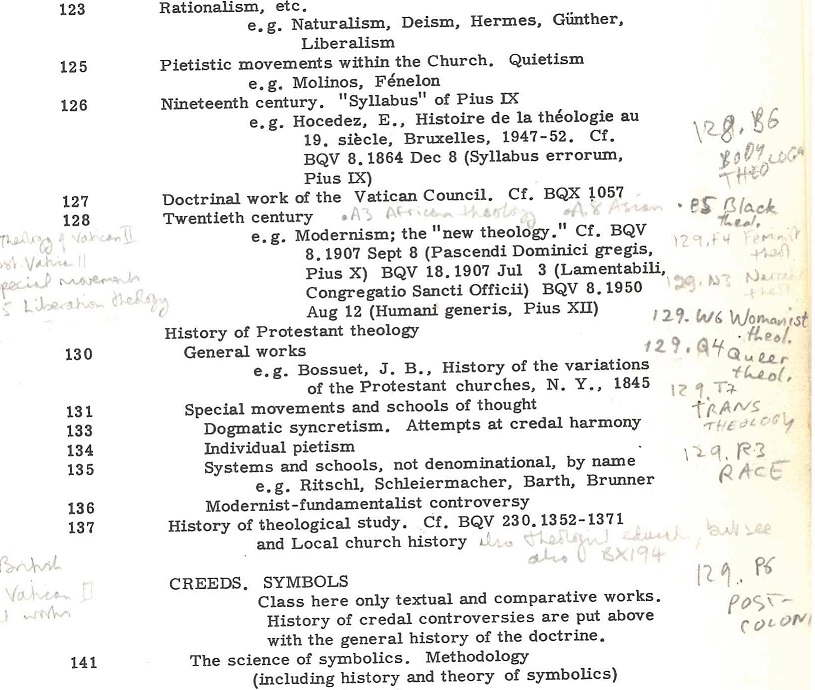
A lot of additions to the Lynn-Peterson were made locally. Our copy’s page of BT128 and BT129 “Twentieth Century” theology is a case in point. The 1954 Lynn-Peterson scheme only knew BT128 as “Twentieth century” and BT129 for “Twenty-first” (or rather post-Vatican II theology), but various new additions have been made in our local copy:

As often for local classificaction scheme, the following seems to have happened: a significant number of new books arriving led to a perceived need to create a new sub-element of twentieth century and with 129 even a main element: twenty-first century theology:
- BT128.5 = Theology of Vatican II,
- BT128.B5 = Black theology
- BT129.F4 = Feminist theology
- BT129.Q4 = Queer theology
- BT129.R3 = Race and theology
- BT129.P6 = Post-colonial theology
- BT129.W6 = Womanist theology
When you also look carefully at the top of the scanned page, you see that Lynn-Peterson suggests to use BQT, but Heythrop (College) Librarians decided to simplify this by crossing out the “Q”. Which means that these classmarks read as BT – these then definitely look like LCC classmarks.
In our third and last instalment of this mini series explaining our classification, we will focus on BX and Jesuitica. Whereas BX is just a “more” Catholic approach to Church History than LCC, it also contains the third modifications we make in classmarks: a completely home-made BX scheme for Jesuitica!
CG
Leave a Reply to Work experience February 2026 – Heythrop LibraryCancel reply