
This is the third post in a series for our blog. It shares the reports written by Alison Felstead, Rare Books Cataloguer at Campion Hall, who has since April 2024 done sterling work on creating detailed records for those Heythrop Library rare books which are stored at Campion Hall. Below is the report received by Alison for the Heythrop Library Committee meeting in February 2025.
At the time of writing, 564 books (i.e. discrete bibliographical entities) have been catalogued onto the Oxford Libraries Information System (OLIS) and made available to scholars worldwide via the University’s SOLO resource discovery interface. To date, about forty-two percent of the material catalogued represents titles not previously represented in SOLO.
When the books arrived at Campion Hall in July 2018 they were divided into regular and folio size and shelved in two sequences, to make best use of the space in the new rolling stacks. I am pleased to report that I have recently completed the cataloguing of the 548 books in the regular-size sequence and have started work on the folios.
As the books are shelved in classification order, the end of the regular-size sequence included several interesting items outside of the theological and philosophical emphases of the collection. Amongst the science books, the most unexpected was a mid-18th century book of cures for equine ailments, Mr. Gibson’s short practical method of cure for horses by William Gibson (London, 1755; SF955 GIB). This item is particularly interesting, as it has been rebound with blank sheets interleaved with the printed pages, and the blank sheets have been used to record remedies for a wide variety of human ailments, along with a few recipes. These are generally handwritten, although some have been clipped from magazines or newspapers and pasted onto the blank sheets. Some include dates from the 1770s to the 1840s.

Brief notes on some of the other more interesting items catalogued since my last report on 11 October 2024 follow:
1) A first edition of Isaac Newton’s Opticks: or, A treatise of the reflexions, refractions, inflexions and colours of light (London, 1704; Q157.N4.O3) which bears the inscription “Bib: Maj: Coll: Angl: Soctis. Jesu Leodij” indicating its provenance to be the English College in Liège, one of the earliest incarnations of Heythrop College.

2) A first edition of Edward Slaughter’s mathematical treatise Arithmetica methodicè et succinctè tradita, adjunctâ ad praxim ratione (Liège, 1702; QA33 SLA) with an inscription by the author at the foot of the title-page: “R.P. Rodulpho Gower Servus in Christo Edw: Slaughter.” Slaughter taught mathematics and Hebrew at Liège and died there in 1729.

3) A French meteorological book from the library of Sir Nevil Maskelyne (1732-1811) the Astronomer Royal, famous for scientifically measuring the mass of the Earth and for initiating the annual publication of Britain’s Nautical almanac. An inscription on the upper paste-down reads “E Libris Nevil Maskelyne D.D. F.R.S. Astron. Reg.” (Reflexions sur la cause generale des vents by Jean Le Rond d’Alembert (Paris, 1747; QC19 ALE)).

4) John Henry Newman’s own copy of Lyra apostolica (4th edition, Derby/Oxford/London, 1840; BZ5100 LYR), a slim volume of religious poetry which he edited and to which he contributed several poems. It is inscribed “John H Newman Oriel College 1840”, written when he was in his late 30s and a fellow at Oriel College, five years before he was received into the Catholic Church.

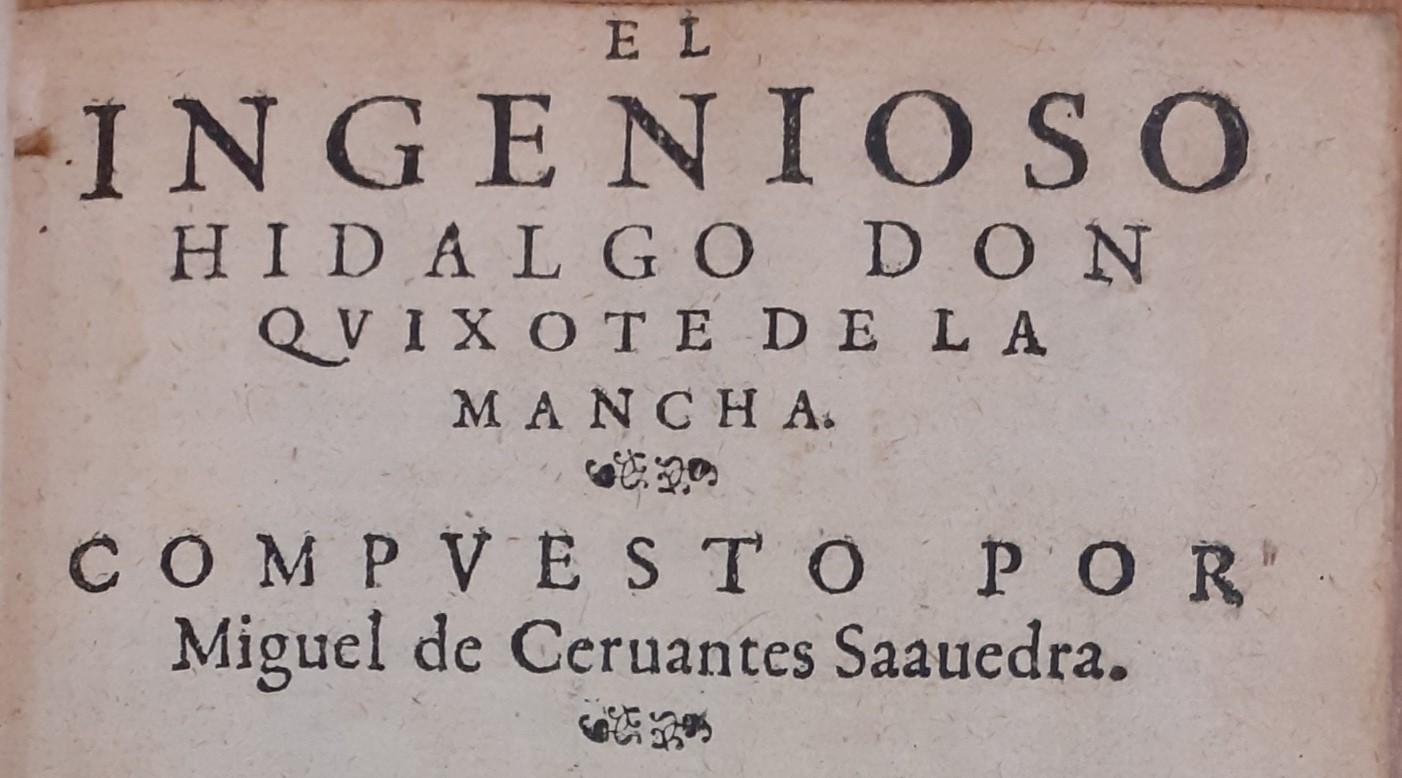
5) An early 17th century set of Cervantes’ Don Quixote in two parts, published in Brussels (1611 and 1616; PQ6323 CER). The fine continental binding bears an armorial stamp incorporating a coronet and the monogram “GG”, whose owner has so far evaded identification.

Alison Felstead, Rare Books Cataloguer, Campion Hall (10 February 2025)


What are your thoughts about the above?