
This is a new series for our blog. It shares the reports written by Alison Felstead, Rare Books Cataloguer at Campion Hall, who has since April 2024 done sterling work on creating detailed records of Heythrop Library rare books which are stored at Campion Hall. Below is the report received by Alison for the Heythrop Library Committee meeting in June 2024.
On average, eight items per day are being catalogued onto the Oxford Libraries Information System (OLIS) and made available to scholars worldwide via the SOLO resource discovery interface. Most of the material catalogued so far dates from the 16th and 17th centuries. A large proportion of it is in Latin, as would be expected, and about ten percent represents titles not previously represented in SOLO.
The following examples give a flavour of the cataloguing challenges encountered so far:
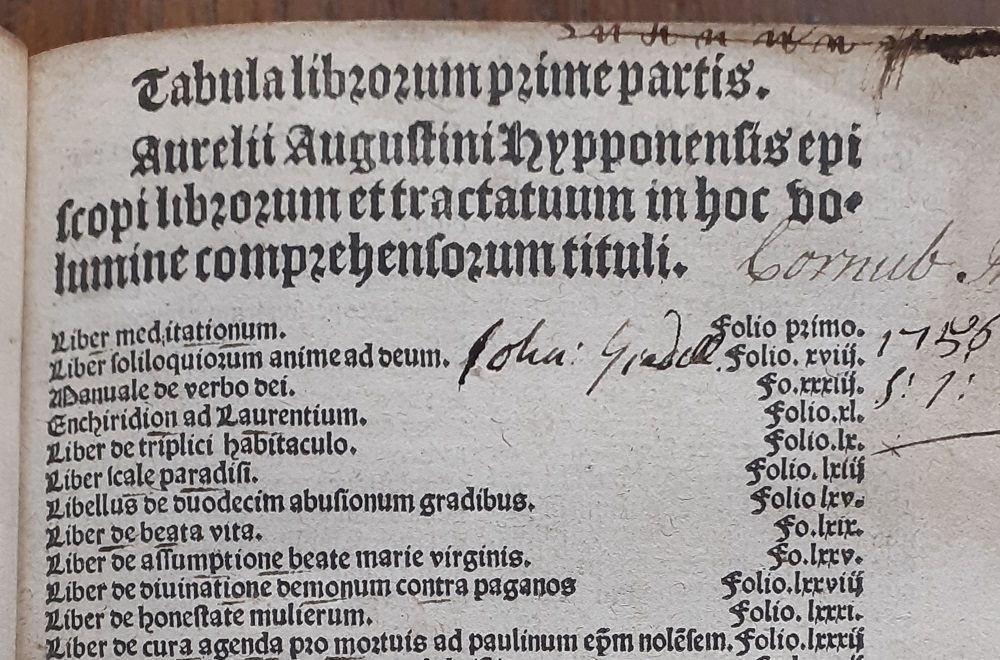
1) A 1513 French edition of the works of Augustine (BQ5672 AUG) lacked the title-page, from which much of the information required to identify the item and create the catalogue record is taken. The record in the Heythrop catalogue was misleading, as the title was incorrect. Research into digital surrogates was necessary to find a complete copy (located in the Bibliotheque National de France’s Gallica system) before the item could be catalogued.
2) What, according to the Heythrop catalogue, appeared to be two identical copies of Louis de Molina’s Concordia liberi arbitrii cum gratiae donis of 1588 (BQ7077.M75.C6, a commentary on Aquinas’ Summa theologica pars 1) turned out to have different bookseller information on the title-pages and therefore required separate bibliographic records.


In addition, one of the copies included a 1598 appendix to the original work bound-in at the end of the volume, which required its own bibliographic record. See https://solo.bodleian.ox.ac.uk/permalink/44OXF_INST/12jkns0/alma991026805524907026
3) Heythrop’s copy of a five-volume set of Benedictus Pererius’ Selectarum disputationum in Sacram Scripturam (2nd edition, 1602-1610) wants all but the second volume (printed in 1604), and the earlier catalogue record described only this volume. In this situation, the cataloguer in a union catalogue environment such as Oxford must endeavour to create a record that represents a perfect set. Heythrop also has the first volume of the 3rd edition (1607), which was particularly challenging to catalogue because no complete set exists in Oxford for comparison and none of the bibliographic databases consulted could supply sufficient details of the remaining four volumes.
4) One volume which had previously been catalogued on a single record (BQ7123.W26.C6: The controversial letters, attributed to Peter Walsh, 1673-1679) was actually found to contain six discrete works, each requiring its own record.
5) There is a wealth of provenance information in many of the items, ranging from bookplates and stamps from a range of Jesuit institutions (which are sometimes but not always easy to identify [and the Jesuit Book Provenance Project at the Jesuit Archive has been useful in this respect]), to armorial bindings of noblemen, to hand-written provenance names and inscriptions in a range of languages. As part of the cataloguing process, provenances are recorded in a standardized way wherever possible. If it is not relatively easy to identify a former ownership stamp or decipher a hand-written name, this information is photographed and logged for future research.
Some interesting provenances have been discovered, not previously noted in earlier catalogue records. These include
(1) a 1607 edition of Robert Persons’ The Christian directory (BQ7095.C4 1607) previously owned and annotated by Giles Oldisworth (1619-1678), a scholar of John Donne and self-described “Holy royalist”;

(2) A 1593 edition of Persons’ Elizabethae Reginae Angliae edictum (BQ7095.E4), which has a 17th century armorial binding in red Morocco identified as belonging to the Spanish nobleman Ramiro de Guzmán, duque de Medina de las Torres (approximately 1600-1668); and
(3) One of two copies of the Clementine Bible of 1635 (BS180), which bears the ownership signature of Edward Scarisbrick (1639-1709), a Jesuit who was one of those accused by Titus Oates of the fabricated Popish Plot to assassinate Charles II.

Alison Felstead, Rare Books Cataloguer, Campion Hall (3 June 2024)


What are your thoughts about the above?