
You might ask why a man is writing about International Women’s Day (IWD), why the heading is “give to gain”, and what qualifies me as a librarian to write about it on this blog. I’m not going to overpromise here, but my organisation, The Jesuits in Britain, are interested in social justice, not “only” through the Jesuit Fund for Social Justice, but in many other activities and works, too.
The Heythrop Library has and will regularly buy books by women theologians or women philosophers – indeed, such activities happen more often not close to IWD in late February or at the beginning of March. One could even ask why would anyone want to exclude an author just because they are a woman? Indeed, we recently ordered some more books written by women philosophers as part of widening the pool of authors in our collection; see Philosophy Collection Development 2025-2026. And to turn the first of the above questions on its head: why should a man not write about IWD, or indeed be interested in equality? Even if I might not suffer directly, I can still relate to issues of inequality and try to show empathy to those who are marginalised.
This year in the UK the motto of the IWD is ‘give to gain’, and it is described as a ‘mindset of collaboration and generosity’ (see IWD: International Women’s Day 2026 theme is ‘Give To Gain’, last access 3 March 2026). Unless you don’t return our library’s books or indeed do not respond to our communications, a library’s activities are based around the idea of generosity and collaboration.
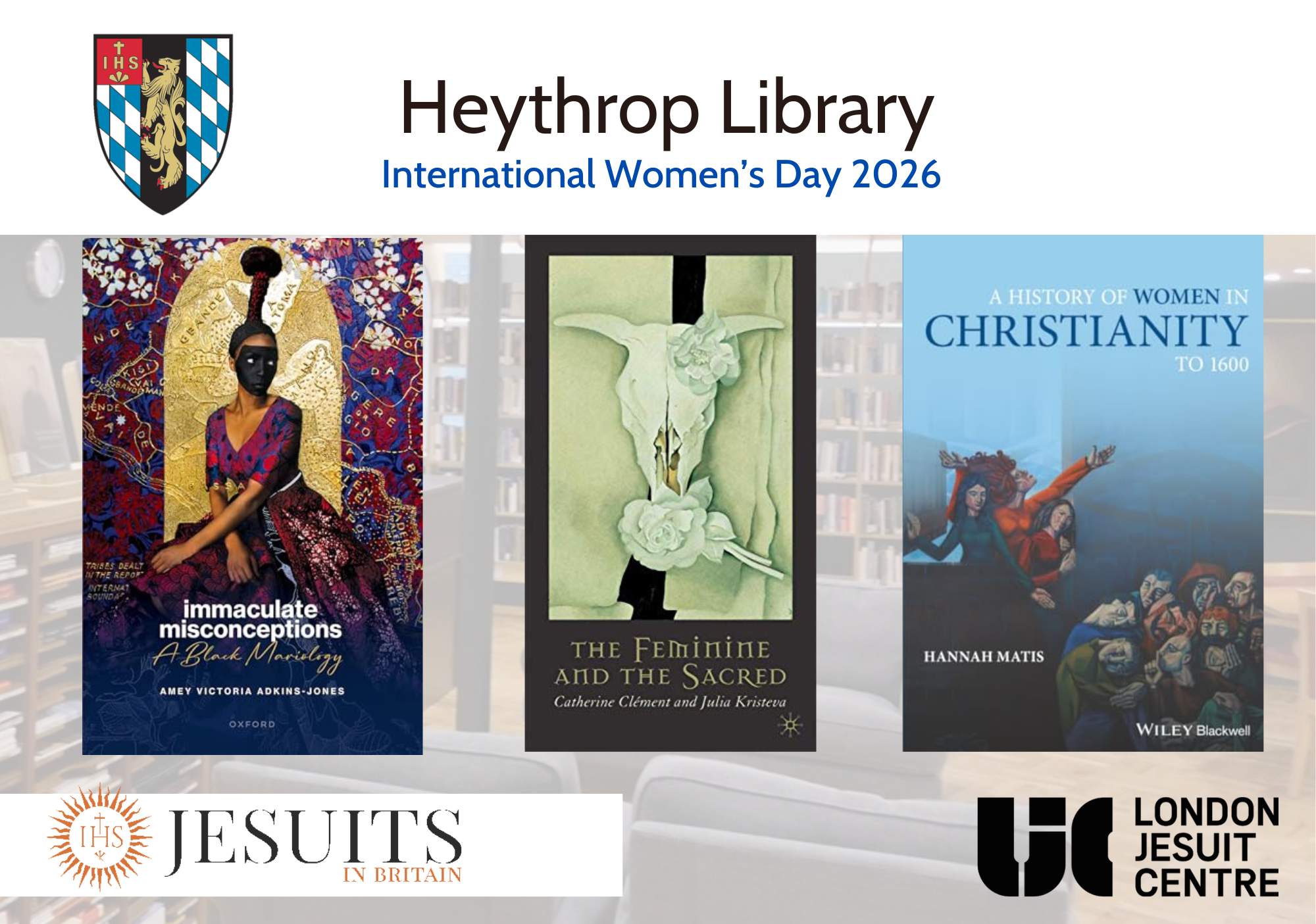
Normally, in these posts we highlight books we have come across relatively recently and which focus on women academics, and/or books discussing issues of gender and equality. The first one is

Immaculate misconceptions : a black mariology / Amey Victoria Adkins-Jones.
By: Adkins-Jones, Amey Victoria [author.]
Publisher: New York : Oxford University Press, 2025
Description: 244 pages : illustrations ; 24 cm
ISBN: 9780198950042
Heythrop Library catalogue record: https://hey.koha.openfifth.net/cgi-bin/koha/opac-detail.pl?biblionumber=98563
The book has been described as offering ‘a layered journey through art, theology, and culture to consider a theology arising from the condition of the Black Mother, following the condition of the Black Madonna, and for the consideration of all those who pursue justice and life at the spiritual intersections of the world.’ (https://bcbookmarks.com/2025/05/01/a-black-mariology/, last accessed 3 March 2026).
The following was only acquired by us recently, but is book which was published in 2001:

The feminine and the sacred / Catherine Clément and Julia Kristeva ; translated by Jane Marie Todd.
By: Clément, Catherine, 1939- [author.]
Contributor(s): Kristeva, Julia, 1941- [author.] Todd, Jane Marie, 1957- [translator.]
Publisher: Basingstoke : Palgrave, 2001
Copyright date: ©2001
Description: 190 pages : illustrations ; 24 cm
ISBN: 9780333969175 0333969170
Heythrop Library catalogue record: https://hey.koha.openfifth.net/cgi-bin/koha/opac-detail.pl?biblionumber=100566
On PhilPapers the first part of the abstract for this book explains: ‘In November 1996, Catherine Clément and Julia Kristeva began a correspondence exploring the subject of the sacred. In this collection of those letters Catherine Clément approaches the topic from an anthropologist’s point of view while Julia Kristeva responds from a psychoanalytic perspective. Their correspondence leads them to a controversial and fundamental question: is there anything sacred that can at the same time be considered strictly feminine?’ (https://philpapers.org/rec/CLMTFA, last accessed 3 March 2026).
The third book highlighted in this post looks at the history of women in Christianity before 1600, documenting their lives:

A history of women in Christianity to 1600 / Hannah Matis.
By: Matis, Hannah W [author.]
Publisher: Chichester : John Wiley & Sons Ltd., 2023
Copyright date: ©2023
Description: vii, 255 pages : illustrations (black and white) ; 26 cm
ISBN: 9781119756613 1119756618
Heythrop Library catalogue record: https://hey.koha.openfifth.net/cgi-bin/koha/opac-detail.pl?biblionumber=100431
To me, three chapters seem particularly poignant for exploring the place of women within Christianity and the societies they lived in: chapter 8 (Clare and company : the social mystics, 1200-1300) hones in on Clare of Assisi’s hunger strike against the papacy and how the religious community around her was seen as a challenge to the mainstream, papal order. Chapter 9 (The political visionary, 1300-1500) charts how outspoken medieval women were seen as a political threat; women such as Catherine of Sienna, Bridget of Sweden and Marguerite Porete (more books on Marguerite Porete in our collection) challenged the perception of women as not being strong or having opinions. Chapter 11 (Women in the Catholic Reformation, 1500-1600) also includes a small section on recusant women and the Jesuits. Hannah Matis writes, ‘Because women could not hold property in their own names, they were paradoxically difficult to target by the courts [of Elizabeth I], and made ideal allies for [Catholic] priests precisely because the Elizabethan Settlement had already declared them to be, in effect invisible’ (page 229).
The three books above might entice you to explore these and other books to study women, their lives and their struggles. Of course, you don’t have to do this today, on IWD 2026. To give a bit of attention to these matters is not just for one Friday in March, it is for many days throughout the year. To give is definitely to gain!
CG